Technology for low noise/low vibration
- Original Technology and Production System
- HRH gear / Hypoid gear
- Technology for low noise/low vibration
Low noise/low vibration tooth surface finishing table (cylindrical gears/bevel gears)
We offer a range of machining methods, enabling selection of the ideal option by balancing tooth surface precision, cost, and performance.
| Cylindrical/Bevel gear | Cylindrical gear | Bevel gear | |||
| Gear surface grinding | Hard Hobbing | Gear cutting | CBN gear tooth grinding | Gear cutting | |
| Gear Precision | Class 0-1 | Class 2-3 | Class 4 | Class 1-2 | Class 4 |
| Quiet operation | Very good | Good | General | Good | General |
| Gear Correction | Tooth profile and tooth contact can be modified |
Tooth profile can be modified | Basically N/A | Tooth contact can be modified | Tooth contact can be modified |
| Delivery | Middle | Middle | Short | Middle | Short |
| Cost | High | Middle | Low | Middle | Low |
Gear accuracy: Cylindrical JIS B1702 / Bevel JIS B1704
In addition to tooth surface finishing, we also provide tooth profile modification for cylindrical gears and tooth contact analysis for bevel gears.
We propose the optimal technologies in accordance with a wide range of needs.
Cylindrical gear
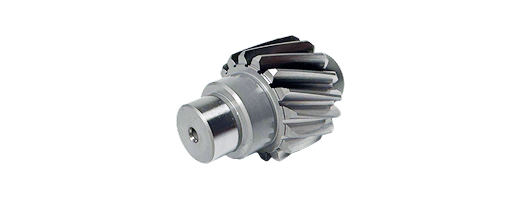
Bevel gear
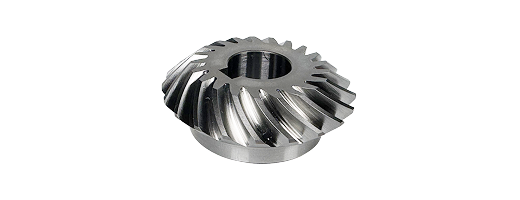
Cylindrical gear
Tooth Profile Modification
Gear grinding is the final tooth surface finishing process, in which distortions caused by heat treatment are removed using a grinding wheel
to improve gear accuracy. High-precision gear grinding reduces noise and vibration generated during operation, enabling efficient power
transmission.
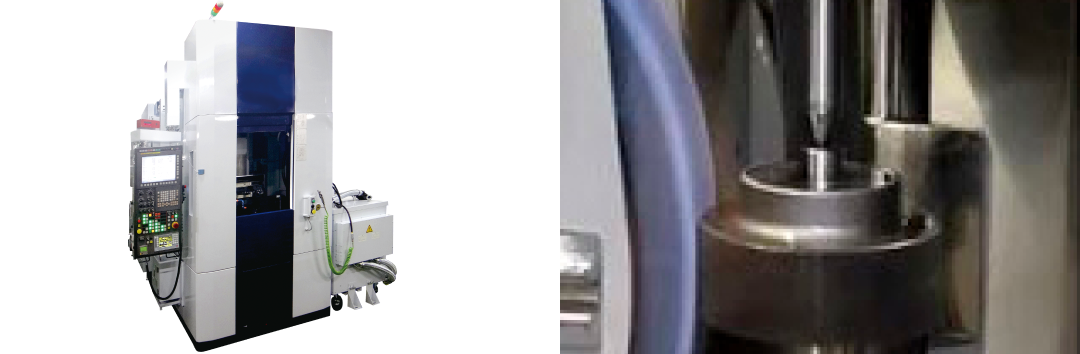
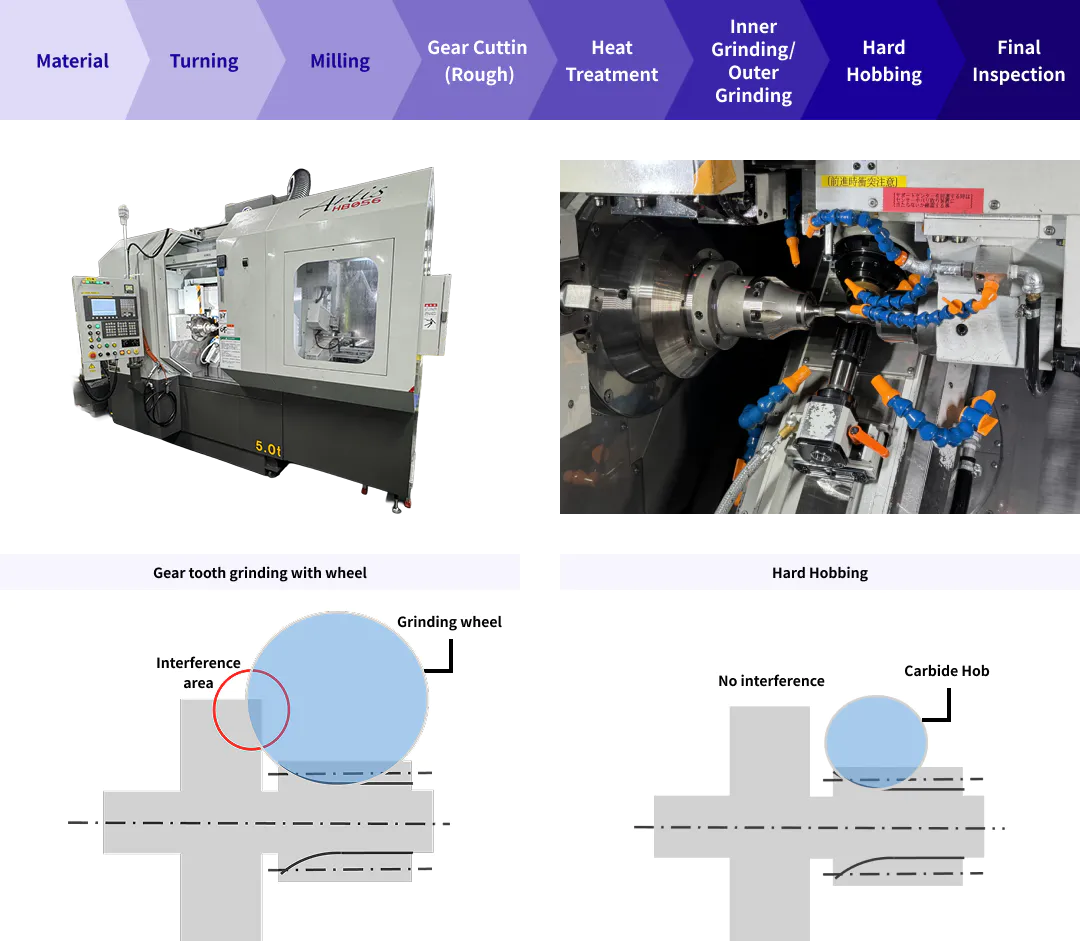
Hard Hobbing
Hard hobbing is a finishing process in which heat-treated high-hardness gears are re-hobbed (cut) using a carbide hob. Because the tool
diameter is small, this method allows machining while minimizing interference with the workpiece shape and surrounding parts.
Tooth Profile Modification
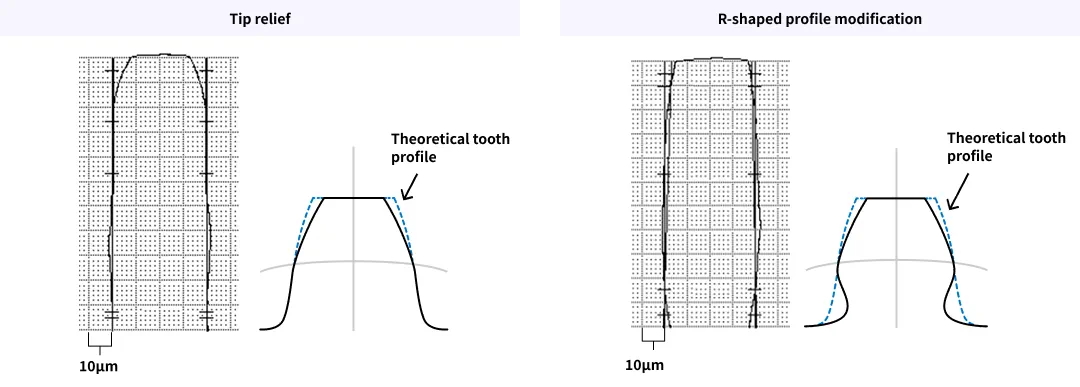
Tooth profile modification is a technique that involves slightly adjusting the gear tooth profile to achieve optimal tooth contact under actual
operating conditions.
Even if the tooth profile is theoretically correct, factors such as load, assembly errors, and shaft deflection may cause
tooth contact to concentrate at the tooth tip or in localized areas during operation.
If the current product has noise issues, we propose tip relief
or R-shaped profile modifications.
Bevel gear
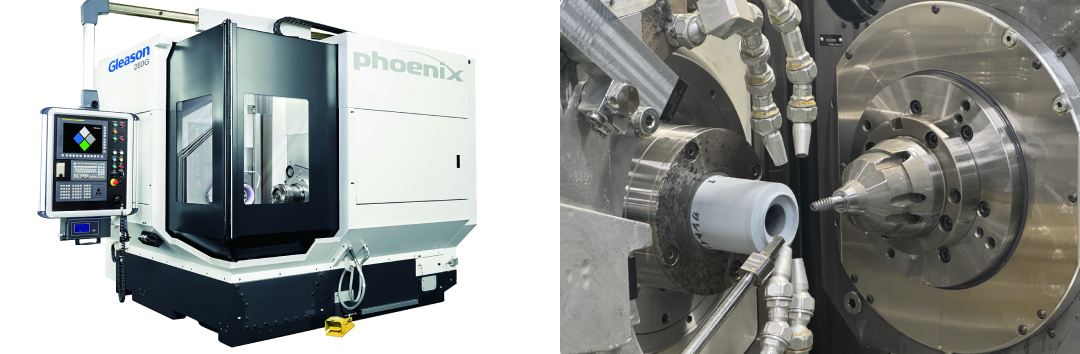
Gear surface grinding
Gear grinding is the final tooth surface finishing process, in which distortions caused by heat treatment are removed using a grinding wheel to
improve gear accuracy. High-precision gear grinding reduces noise and vibration generated during operation, enabling efficient power
transmission.
Precision by finishing method
| Gear tooth grinding with wheel | CBN gear tooth grinding | |
| Backlash Control Value | 0.05 | 0.05 |
| Gear Precision | JIS Grade 0-1 | JIS Grade 1-2 |
| Surface Roughness | Ra1.6 | Ra2.4 |
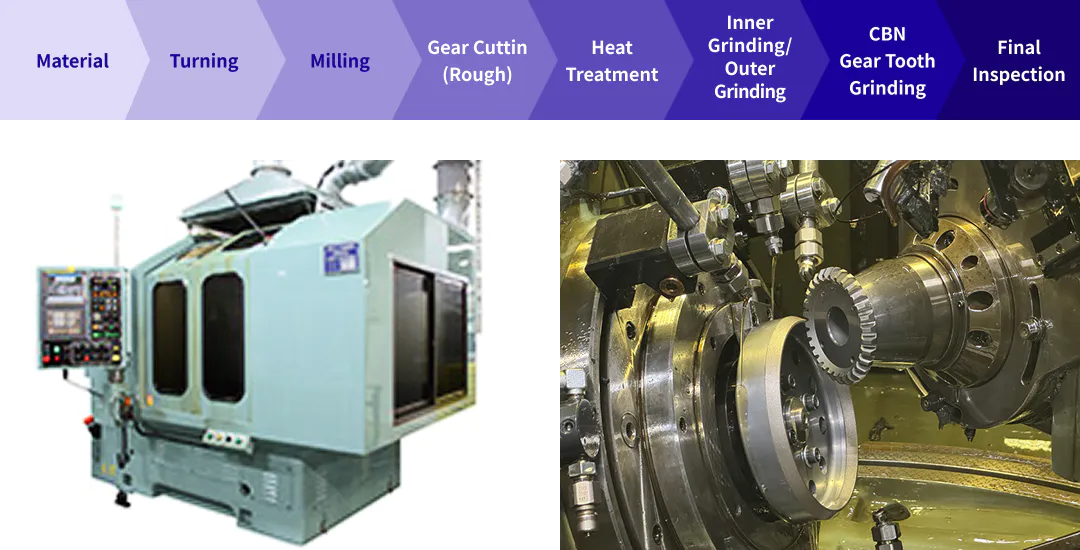
CBN gear tooth grinding
CBN grinding is a machining technology that uses electroplated CBN grinding wheels to efficiently remove distortion after heat treatment and
produce high‑precision gears.
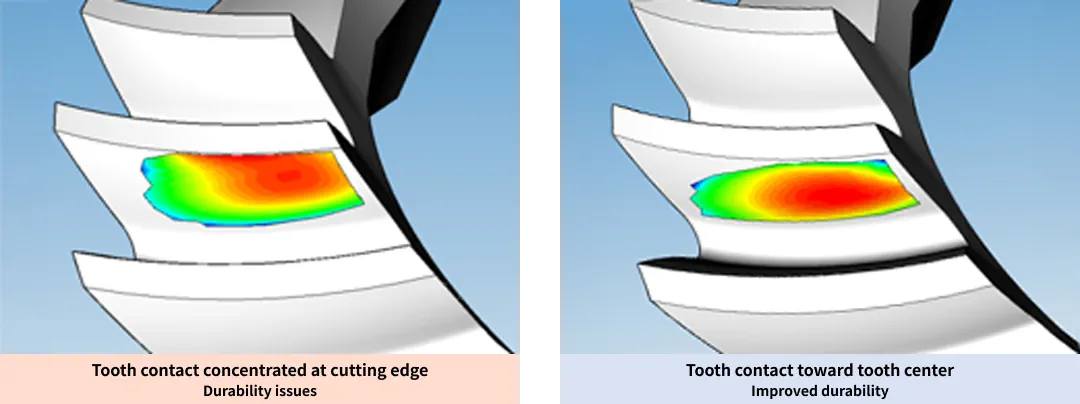
Tooth Contact Analysis
By simulating optimal tooth contact and meshing curves, we aim to achieve gears with low vibration and low noise. With our machining
technologies, tooth profile errors and tooth surface roughness can be reduced to achieve smooth meshing and improved durability.